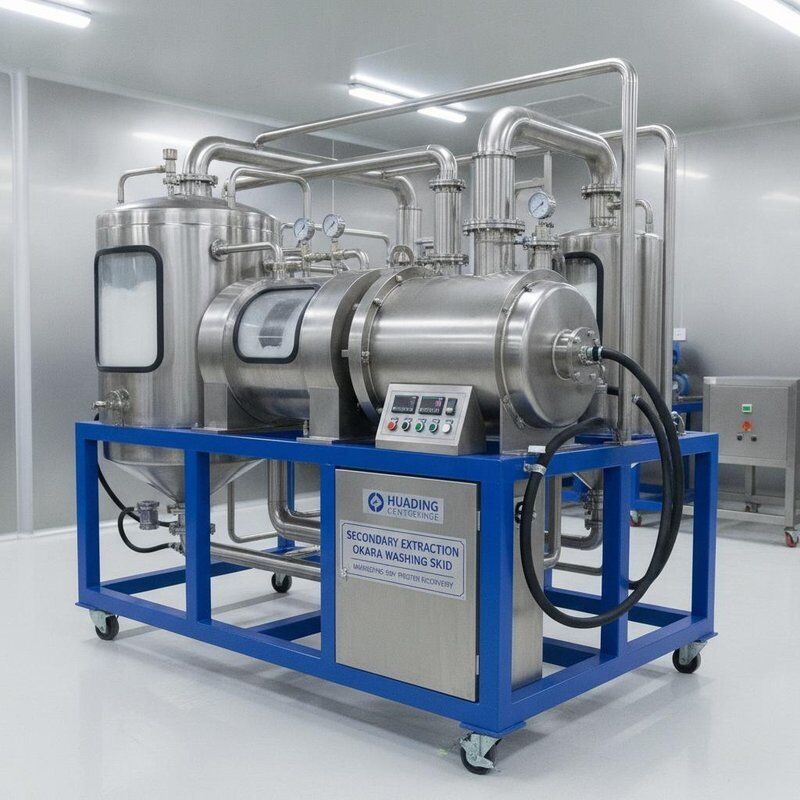
Product Details
Place of Origin: Yixing, Jiangsu, China
Brand Name: Huading
Certification: ISO 9001:2015, CE
Model Number: LW450D two stage
Payment & Shipping Terms
Minimum Order Quantity: 1 Set
Price: USD 18000-65000 / Set
Packaging Details: Seaworthy plywood case with rust preventive film, moisture barrier bag and shock absorbing bracing
Delivery Time: 30-45 working days after deposit
Payment Terms: T/T, L/C at sight, Western Union
Supply Ability: 15 Sets per Month
System Type: |
Two Stage Decanter With Washing Loop |
Bowl Diameter: |
450 Mm |
Bowl Speed: |
3500 Rpm |
G-Force: |
3000 G |
Stage Motor: |
18.5 KW Each |
Wash Stages: |
2 (counter Current) |
Protein Recovery: |
Above 92 Percent |
Okara Moisture: |
Below 68 Percent After Washing |
Control: |
PLC With Recipe And Trend Logging |
Contact Material: |
SS304, SS316L Optional |
Application: |
Secondary Soy Extraction, Okara Washing |
In a conventional soy milk line the okara leaving the primary decanter still carries between 8 and 15 percent of the protein that entered the process. That protein is not lost because it cannot be extracted, it is lost because there is no economical way to wash it out of the fibre. The Huading LW450D two stage system provides that way: a primary decanter separates the okara, the cake is re-slurried with water, and a second decanter presses the washed fibre to recover the dilute protein solution for return to the main stream.
Plants using this configuration routinely lift overall protein recovery from the mid 70s into the low 90s, which converts directly into more soy milk from the same tonnage of beans. The two stages run under a single PLC that balances wash water ratio against cake dryness, so the operator sets a recovery target and the system holds it while feed conditions drift.
Key Features| Parameter | Specification |
|---|---|
| System model | LW450D two stage |
| Bowl diameter | 450 mm |
| Bowl length | 1800 mm |
| Bowl speed | 3500 rpm |
| Maximum g-force | 3000 G |
| Main motor power | 18.5 kW per stage |
| Scroll differential speed | 2-30 rpm, variable |
| Stage 1 duty | Primary okara separation |
| Stage 2 duty | Counter current okara washing |
| Total slurry capacity | 10-18 m3/h |
| Protein recovery | above 92 percent |
| Contact material | SS304 / SS316L option |
| Wash water ratio | 2 to 4 parts water per part okara |
Primary decanter stage one receives the cooked soy slurry and separates okara from soy milk, discharging cake into the wash tank. There the cake is re-slurried with metered wash water and pumped to stage two, where the second decanter separates the dilute protein solution from the washed fibre. The dilute solution is returned to the primary feed, while the washed okara leaves as a low moisture cake. The PLC watches density and flow and adjusts water dosing and differential speed to hold the recovery target.
ApplicationsThis system suits soy milk and tofu plants, soy protein concentrate lines, and beverage factories producing soy, rice, oat and nut milks where soluble solids remain trapped in the fibre after primary separation. It is also used to recover solids from fruit pulp wash and from starch fibre streams.
Packaging and Quality AssuranceThe module ships as two plywood cases for the decanters plus a crate for the wash tank, dosing pump and control panel, all with rust preventive treatment and internal bracing. Documentation covers P and ID drawings, electrical schematics, PLC backup, operating procedures, spare parts lists and material certificates, together with a commissioning checklist for the two stage loop.